Building Evals
An Eval is the executable form of a Rubric. It binds each rubric dimension to specific judges, with optional custom pipelines and per-judge configuration.
→ For defining judges, see Creating Judges.
→ For pipeline authoring, see Authoring Pipelines.
Creating an Eval in the UI
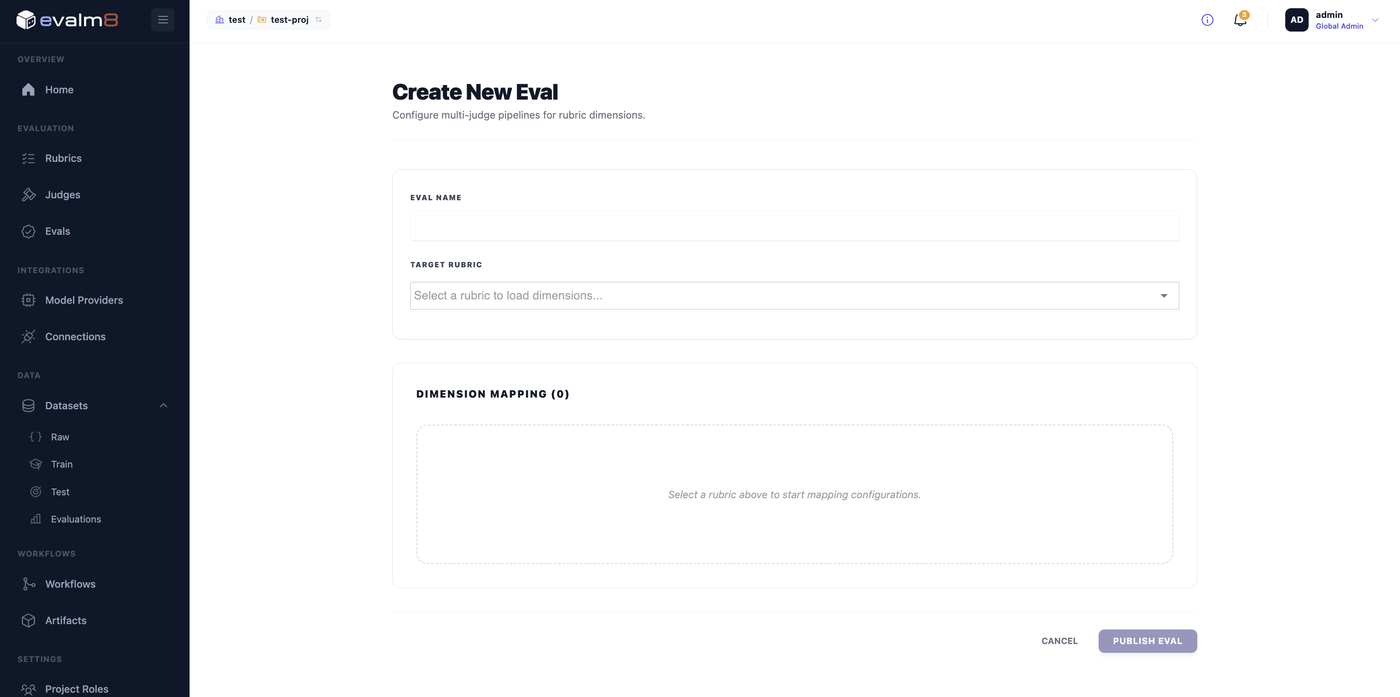
Go to Evaluation → Evals and click Create Eval. Select a rubric, then configure a judge binding for each dimension.
Eval Structure
{
  "name": "product_quality_eval",
  "rubric_uri": "eart://rubrics/product_quality",
  "bindings": [ ... ]
}
| Field | Description |
|---|---|
name | Unique name for this eval. |
rubric_uri | URI of the rubric this eval implements. |
bindings | One JudgeBinding per rubric dimension, in positional order. The first binding grades the first dimension, the second the second, and so on. |
Judge Bindings
Each binding is a recipe for scoring one rubric dimension.
{
  "judges": [
    {
      "id": "hallucination",
      "judge_uri": "eart://judges/bespoke/hallucination_check",
      "config": null
    }
  ],
  "pipeline": null
}
Judge References
Each entry in judges is a reference to a stored judge:
| Field | Required | Description |
|---|---|---|
id | Yes | Local identifier for this judge within this eval. Used as judge_id in pipeline call steps. |
judge_uri | Yes | URI of the judge artifact. Append ?ref=v3 to pin a version. Omit it for latest. |
config | No | Per-judge configuration dictionary merged into the pipeline context. |
Use a local id
The id is a local alias scoped to this eval. It lets you configure and reference the same judge as distinct entries:
- The same judge can appear multiple times with different configurations. A pipeline might call a generic "page_comparison" judge once for URL matching and once for title matching, each with a different
config. - Pipeline
callsteps reference judges byid, not by URI.
{
  "judges": [
    {
      "id": "url_match",
      "judge_uri": "eart://judges/bespoke/page_comparison",
      "config": { "comparison_field": "url" }
    },
    {
      "id": "title_match",
      "judge_uri": "eart://judges/bespoke/page_comparison",
      "config": { "comparison_field": "title" }
    }
  ],
  "pipeline": { "steps": [ ... ] }
}
Both point to the same judge artifact, but the pipeline calls them as two separate judges via "judge_id": "url_match" and "judge_id": "title_match".
Judge Configuration
The config dictionary makes judges reusable across bindings. The executor merges config values into the pipeline execution context before it evaluates input_mapping. You can reference them in mapping paths or auto-wire them by name. A judge input named schema connects to a config key named schema.
Common uses:
- JSON schemas for a generic validation judge
- Thresholds:
{ "min_length": 100, "max_length": 2000 } - Comparison parameters:
{ "comparison_field": "url" } - Reference data:
{ "expected_output": "Paris" }
Example: Reusable Schema Judge
Judge (created once):
{
  "type": "code",
  "name": "json_schema_validator",
  "inputs": [
    { "name": "response", "target_type": "string" },
    { "name": "schema", "target_type": "dict" }
  ],
  "code": "..."
}
Eval binding (reused with different schemas):
{
  "judges": [{
    "id": "product_schema",
    "judge_uri": "eart://judges/bespoke/json_schema_validator",
    "config": {
      "schema": {
        "type": "object",
        "required": ["product_id", "name", "price"]
      }
    }
  }]
}
The schema config auto-wires to the judge's schema input. The pipeline only needs to provide response.
The Default Pipeline
When a binding has a single judge and no pipeline, Evalm8 synthesises a default two-step pipeline:
Step 1: heuristic extract → Step 2: call the judge
The heuristic resolver extracts common inputs from the last LLM span in the trace.
Heuristic inputs
| Variable | Source | Description |
|---|---|---|
query | Last user-role message across all LLM spans | The most recent user turn |
response | Last assistant-role output, or last tool call | The model's response |
instruction | Last system-role message across all LLM spans | The system prompt |
tool_calls | Last message.tool_calls from output messages | Tool invocations |
tool_definitions | input.value.tools attribute | Tool schemas available to the model |
history | All input messages except the last from the target span, or all inputs from prior LLM spans | Conversation history |
Shim Mappings
Evalm8 maps these domain-specific judge input names for you:
| Judge input name | Maps to |
|---|---|
plan | query |
tool_responses | query |
action | response |
observation | response |
reflection | response |
reference_response | reference |
context | instruction |
history | instruction |
messages | instruction |
memory | instruction |
reference_tool_calls | tool_calls |
An agent-oriented judge expecting action and observation works without custom extraction.
If a requested field name already exists in the execution context from a prior step, the heuristic skips re-extraction and uses the existing value. This lets you override specific fields while using heuristic extraction for the rest.
Default pipeline criteria
Use the default when:
- Your judge's inputs match the standard names above (or their shim aliases).
- Your trace follows OpenInference conventions.
- You don't need guards, list iteration, branching, or complex transforms.
Write an explicit pipeline when:
- Your trace uses non-standard attributes or needs regex/JSON parsing.
- You iterate over a list of items (map/reduce).
- You need guards to reject invalid traces.
- You branch on content type (switch).
- You orchestrate multiple judges together.
Multi-Judge Bindings
When a binding has more than one judge, you must provide a pipeline.
Sequential Judges
{
  "judges": [
    { "id": "extract_facts", "judge_uri": "eart://judges/bespoke/fact_extractor" },
    { "id": "verify_facts", "judge_uri": "eart://judges/bespoke/fact_verifier" }
  ],
  "pipeline": {
    "steps": [
      { "id": "inputs", "type": "extract", "resolver": { "type": "heuristic" } },
      { "id": "facts", "type": "call", "judge_id": "extract_facts",
        "input_mapping": { "response": "inputs.response" } },
      { "id": "verification", "type": "call", "judge_id": "verify_facts",
        "input_mapping": { "facts": "facts", "response": "inputs.response" } }
    ]
  }
}
Map Over Items
{
  "judges": [
    { "id": "item_scorer", "judge_uri": "eart://judges/bespoke/relevance_check" }
  ],
  "pipeline": {
    "steps": [
      { "id": "extracted", "type": "extract", "resolver": { "type": "code",
        "code": "import json; output = json.loads(trace.spans[0].attributes.get('llm.output_messages', [{}])[0].get('message.content', '{}')); result = {'items': output.get('selected_items', [])}" } },
      { "id": "scores", "type": "map", "iterator_ref": "extracted.items",
        "item_alias": "current_item", "parallelism": 5,
        "steps": [
          { "id": "score_item", "type": "call", "judge_id": "item_scorer",
            "input_mapping": { "item": "current_item" } }
        ] },
      { "id": "final", "type": "reduce", "input_ref": "scores",
        "aggregation": { "strategy": "average" } }
    ]
  }
}
Complete Example
A two-dimension eval: relevancy (LLM judge with heuristic extraction + guard) and schema validation (deterministic judge with config).
Rubric
{
  "name": "product_quality",
  "description": "Evaluates product matching quality",
  "dimensions": [
    {
      "name": "relevancy",
      "description": "Are selected products relevant?",
      "scale": { "type": "binary", "min": 0, "max": 1 },
      "weight": 2.0
    },
    {
      "name": "schema",
      "description": "Is the output valid JSON?",
      "scale": { "type": "binary", "min": 0, "max": 1 },
      "weight": 1.0
    }
  ],
  "passing_score_threshold": 0.7
}
Eval
{
  "name": "product_quality_eval",
  "rubric_uri": "eart://rubrics/product_quality",
  "bindings": [
    {
      "judges": [{ "id": "relevance_judge", "judge_uri": "eart://judges/bespoke/product_relevance" }],
      "pipeline": {
        "steps": [
          { "id": "guard_llm", "type": "guard",
            "condition": "trace.spans.filter(s, s['openinference.span.kind'] == 'LLM').size() > 0",
            "on_fail": { "result": { "score": 0, "reason": "No LLM span." }, "reason": "Early exit." } },
          { "id": "inputs", "type": "extract", "resolver": { "type": "heuristic" } },
          { "id": "result", "type": "call", "judge_id": "relevance_judge",
            "input_mapping": { "query": "inputs.query", "response": "inputs.response" } }
        ]
      }
    },
    {
      "judges": [{
        "id": "schema_check",
        "judge_uri": "eart://judges/bespoke/json_schema_validator",
        "config": { "schema": { "type": "object", "required": ["selected_product_ids"] } }
      }],
      "pipeline": {
        "steps": [
          { "id": "output", "type": "extract", "resolver": { "type": "cel",
            "mapping": { "response": "trace.spans[0].attributes['llm.output_messages'][0]['message.content']" } } },
          { "id": "check", "type": "call", "judge_id": "schema_check",
            "input_mapping": { "response": "output.response" } }
        ]
      }
    }
  ]
}
Quick Reference
| Concept | Key point |
|---|---|
| Binding order | Positional. The Nth binding grades the Nth rubric dimension. |
Judge id | Local alias within the eval. Referenced by call steps. |
| Same judge, multiple uses | Different id, different config |
config | Merged into pipeline context. Auto-wired by matching name. |
| No pipeline | Valid only with a single judge. Default: heuristic extract → call. |
| Multi-judge | Pipeline required. |
| Versioning | ?ref=v3 pins a judge version. Omit for latest. |
Next steps
| Guide | Covers |
|---|---|
| Core Concepts | Traces, Rubrics, Dimensions |
| Creating Judges | Defining judges and writing code snippets |
| Authoring Pipelines | Full step reference and patterns |
| Workflows | Datasets, annotation, and refinement |