Creating Judges
A judge in Evalm8 scores a single aspect of quality. You can define two kinds, LLM judges and deterministic judges.
→ To wire judges into evaluations, see Building Evals.
Judge Types at a Glance
| LLM Judge | Deterministic Judge | |
|---|---|---|
| Type | "llm" | "code" |
| How it works | Sends a prompt to an LLM and parses a structured verdict | Runs a Python snippet in a sandboxed environment |
| Best for | Subjective reasoning: coherence, relevance, hallucination | Deterministic checks: schema validation, regex, exact match |
| Origin | bespoke (fixed prompt) or fine_tuned (learns from annotations) | bespoke |
Creating a Judge in the UI
Go to Evaluation → Judges and click Create Judge.
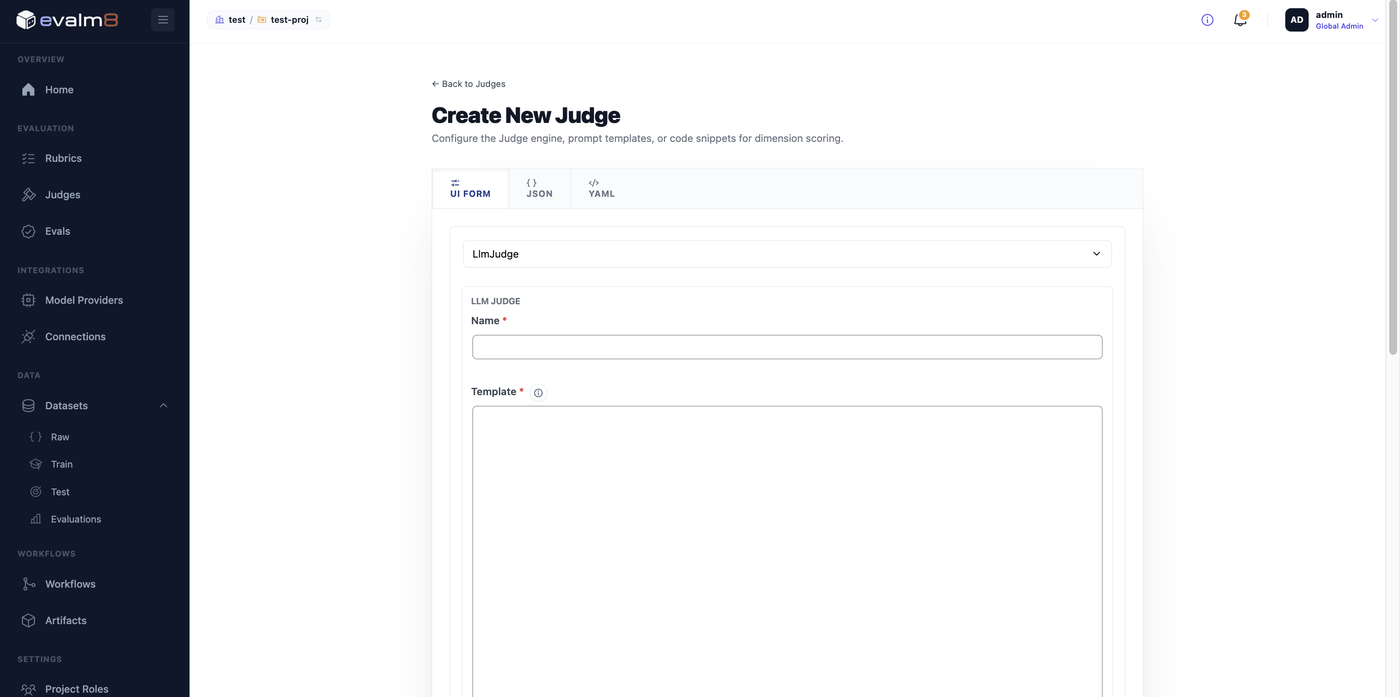
The judge name becomes its slug ID (e.g. Correctness JUDGE → correctness-judge), which evals and pipelines reference.
Common Fields
Both judge types share:
| Field | Required | Description |
|---|---|---|
name | Yes | Unique name. Becomes the judge's slug ID. |
type | Yes | "llm" or "code" |
inputs | Yes | List of input fields the judge expects (at least one). |
mode | No | Scoring mode and scale. Defaults to pointwise with integer 1–5. |
Declaring Inputs
Every judge declares the variables it expects to receive:
"inputs": [
  {
    "name": "response",
    "target_type": "string",
    "description": "The LLM's raw output text"
  },
  {
    "name": "reference",
    "target_type": "string",
    "description": "The expected correct answer"
  }
]
| Property | Required | Description |
|---|---|---|
name | Yes | Variable name your code or prompt template references. |
target_type | No | string, integer, float, boolean, dict, or list. Defaults to string. Evalm8 coerces each value to this type. |
description | No | Human-readable description. Shown in the UI and used as context for LLM judges. |
annotation_template | No | HTML template for rendering this field in the annotation/review interface. |
A judge never extracts data from the trace itself. A pipeline (or the default heuristic pipeline) extracts values from the trace and maps them to these declared input names.
LLM Judges
An LLM judge uses a prompt template and a language model to reason about quality.
{
  "type": "llm",
  "name": "Correctness JUDGE",
  "inputs": [
    { "name": "query", "target_type": "string", "description": "The prompt sent to the model." },
    { "name": "response", "target_type": "string", "description": "The model response to evaluate." }
  ],
  "template": "You are an expert evaluator assessing the correctness of a model response. Score 1 to 5, then explain briefly.\n\nQuery: {{query}}\nResponse: {{response}}",
  "model": "google/gemini-2.5-flash",
  "mode": {
    "type": "pointwise",
    "scale": { "type": "integer", "min": 1, "max": 5 }
  }
}
| Field | Required | Description |
|---|---|---|
template | Yes | The prompt sent to the LLM. Reference inputs with {{variable_name}}. |
model | No | Model provider URI (e.g. google/gemini-2.5-flash). Uses platform default if omitted. |
mode.scale | No | The scoring scale the LLM should use. Defaults to integer 1–5. |
Before using a model for LLM judges, register it under Integrations → Model Providers.
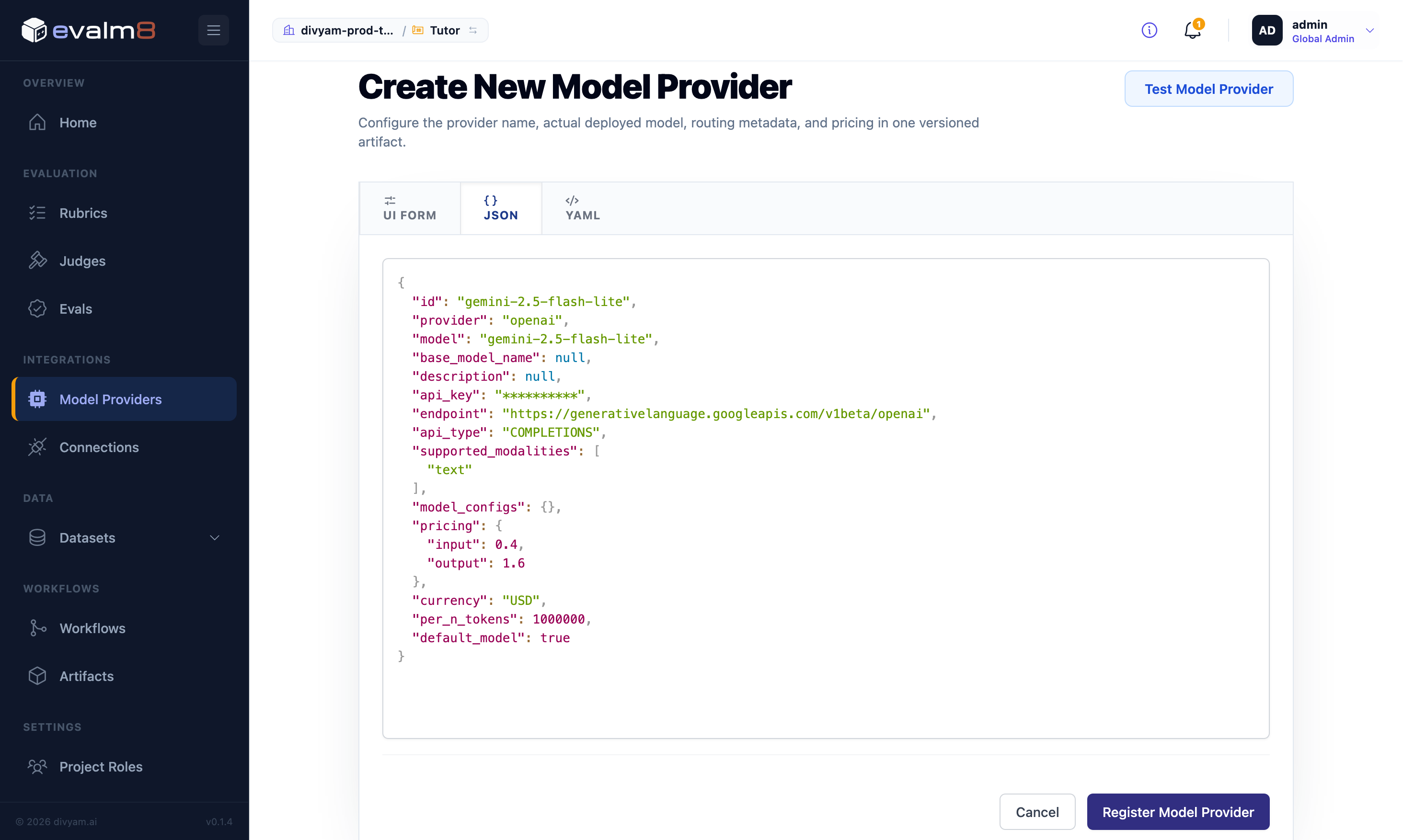
Bespoke vs Fine-Tuned
bespoke: a fixed prompt template. Scores are consistent but do not adapt to your domain without manual prompt editing.fine_tuned: starts from the same template and learns from your golden dataset annotations through the refinement workflow. With each refinement cycle, its scores move closer to human judgment.
Deterministic Judges
A deterministic judge runs a Python snippet in a sandboxed environment. Use it for checks that don't need LLM reasoning.
{
  "type": "code",
  "name": "json_schema_validator",
  "inputs": [
    { "name": "response", "target_type": "string" },
    { "name": "schema", "target_type": "dict" }
  ],
  "code": "try:\n    data = json.loads(response)\n    jsonschema.validate(data, schema)\n    score = 1.0\n    reason = \"Valid JSON conforming to schema\"\nexcept json.JSONDecodeError:\n    score = 0.0\n    reason = \"Output is not valid JSON\"\nexcept jsonschema.ValidationError as e:\n    score = 0.0\n    reason = f\"Schema violation: {e.message}\""
}
Deterministic judge inputs
Your snippet runs with each declared input already available as a local variable. If you declared an input named response, write response in your code. You don't need to unpack anything.
Your snippet must set:
score(numeric): the judge's verdict. It defaults to0.0if not set.reason(string, optional): an explanation. If you omit it, Evalm8 uses a generic fallback.
For ranking judges, set rank (a list of integers) instead of score.
Available in the Sandbox
Pre-imported modules (no import needed):
| Module | Typical use |
|---|---|
math | math.log, math.sqrt, math.ceil |
re | Regex matching and substitution |
json | Parse/dump JSON strings |
jsonschema | Validate dicts against JSON Schema |
datetime | Date/time construction and arithmetic |
collections | Counter, defaultdict, OrderedDict |
itertools | chain, product, combinations |
functools | reduce, partial |
hashlib | md5, sha256 |
statistics | mean, median, stdev |
copy | copy.copy, copy.deepcopy |
Built-in functions: int, float, str, bool, list, dict, set, tuple, len, sum, max, min, round, sorted, range, enumerate, zip, map, filter, any, all, isinstance, abs, print (for debugging), and standard exception types.
Not available: File I/O, networking, system access, or any module not listed above.
Error Handling
If your snippet raises an unhandled exception, Evalm8 reports the error with the offending line number. Use try/except to catch errors and set a score yourself:
try:
    parsed = json.loads(response)
    score = 1.0 if "name" in parsed else 0.0
    reason = "Has 'name' key" if score else "Missing 'name' key"
except json.JSONDecodeError:
    score = 0.0
    reason = "Not valid JSON"
Deterministic Judge Examples
Regex Pattern Gate
pattern = r"\b\d{4}-\d{2}-\d{2}\b"
matches = re.findall(pattern, response)
score = 1.0 if matches else 0.0
reason = f"Found {len(matches)} date(s)" if matches else "No ISO-8601 date found"
Word-Overlap Similarity
ref_tokens = set(reference.lower().split())
res_tokens = set(response.lower().split())
overlap = len(ref_tokens & res_tokens) / len(ref_tokens) if ref_tokens else 1.0
score = round(overlap, 3)
reason = f"Token overlap: {score}"
Exact Match with Normalisation
normalise = lambda s: re.sub(r'\s+', ' ', s.strip().lower())
score = 1.0 if normalise(response) == normalise(expected) else 0.0
reason = "Exact match" if score else "Does not match expected output"
Length Validation
length = len(response.strip())
if length < 10:
    score = 0.0
    reason = "Response too short"
elif length > 2000:
    score = 0.5
    reason = "Excessively long"
else:
    score = 1.0
    reason = f"Acceptable length ({length} chars)"
JSON Schema Validation (with config)
This judge receives schema via judge configuration on the eval binding, so you can reuse it across dimensions:
try:
    data = json.loads(response)
    jsonschema.validate(data, schema)
    score = 1.0
    reason = "Response conforms to the required schema"
except json.JSONDecodeError:
    score = 0.0
    reason = "Response is not valid JSON"
except jsonschema.ValidationError as e:
    score = 0.0
    reason = f"Schema violation: {e.message}"
Next steps
| Guide | Covers |
|---|---|
| Core Concepts | Traces, Rubrics, Dimensions, and the evaluation flow |
| Authoring Pipelines | How to extract trace data and route it to judges |
| Building Evals | Wiring judges to rubric dimensions, configuration, the default pipeline |
| Workflows | Datasets, annotation, and judge refinement |